
The dynamics of behavioral pattern in collaborative problem-solving among Indonesian preservice mathematics teachers
##plugins.themes.bootstrap3.article.sidebar##
##plugins.themes.bootstrap3.article.main##
Abstract
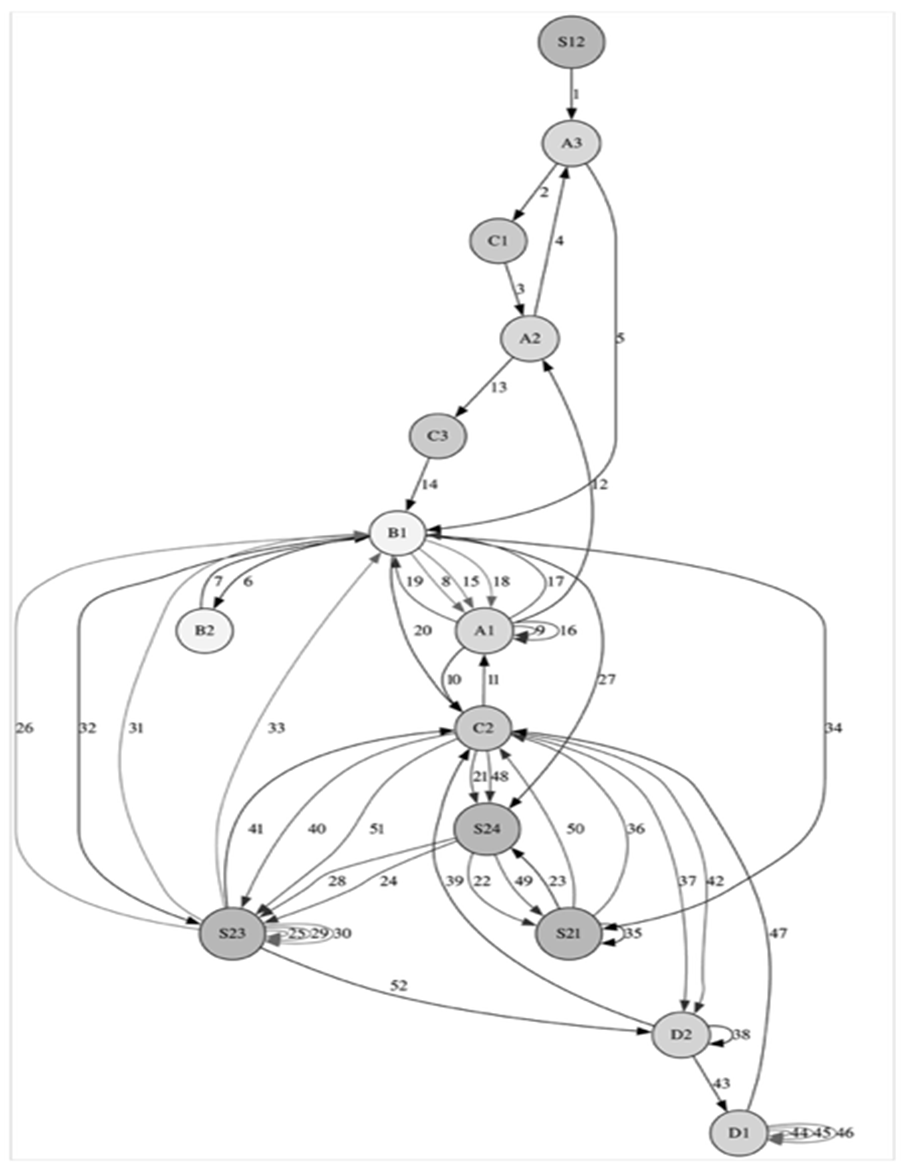
The research examines the behavioral dynamics of Indonesian preservice mathematics teachers and identifies the types of scaffolding they require to enhance their participation in collaborative settings. A key novelty of this research is the application of the Net Promoter Score as a classification framework for grouping preservice teachers in educational research. Using this NPS-based categorization, combined with mathematical problem-solving performance, we conducted a qualitative study involving two underperforming subjects: promoters and passives. The analysis reveals distinct behavioral transition patterns: the promoters group repeatedly shifted actions across different problem-solving steps, while the passives group repeated actions within a single step. Despite these differences, both groups displayed similar needs for scaffolding, i.e. in interpreting actions and coordinating communication. Notably, the promoters group progressed through all four problem-solving steps, whereas the passives group did not reach the final stage. These findings contribute to a deeper understanding of collaborative roles in group-based mathematical problem-solving and highlight the potential of tailored scaffolding to support preservice teachers’ engagement in collaborative mathematical work.
##plugins.themes.bootstrap3.article.details##

This work is licensed under a Creative Commons Attribution-ShareAlike 4.0 International License.
The author is responsible for acquiring the permission(s) to reproduce any copyrighted figures, tables, data, or text that are being used in the submitted paper. Authors should note that text quotations of more than 250 words from a published or copyrighted work will require grant of permission from the original publisher to reprint. The written permission letter(s) must be submitted together with the manuscript.References
Anghileri, J. (2006). Scaffolding practices that enhance mathematics learning. Journal of Mathematics Teacher Education, 9(1), 33–52. https://doi.org/10.1007/s10857-006-9005-9
Barron, B. (2000). Achieving coordination in collaborative problem-solving groups. Journal of the Learning Sciences, 9(4), 403–436. https://doi.org/10.1207/s15327809jls0904_2
Beck, S. W., Jones, K., Storm, S., & Smith, H. (2020). Scaffolding students’ writing processes through dialogic assessment. Journal of Adolescent & Adult Literacy, 63(6), 651–660. https://doi.org/10.1002/jaal.1039
Darius, P. S. H., Gundabattini, E., & Solomon, D. G. (2021). A survey on the effectiveness of online teaching–learning methods for university and college students. Journal of The Institution of Engineers (India): Series B, 102(6), 1325–1334. https://doi.org/10.1007/s40031-021-00581-x
Felmer, P. (2023). Collaborative problem-solving in mathematics. Current Opinion in Behavioral Sciences, 52, 101296. https://doi.org/10.1016/j.cobeha.2023.101296
Fiore, S. M., Graesser, A., Greiff, S., Griffin, P., Gong, B., Kyllonen, P., Massey, C., O’Neil, H., Pellegrino, J., & Rothman, R. (2017). Collaborative problem solving: Considerations for the national assessment of educational progress. National Center for Education Statistics.
Gillies, R. (2016). Cooperative learning: Review of research and practice. Australian Journal of Teacher Education, 41(3), 39–54. https://doi.org/10.14221/ajte.2016v41n3.3
Gopal, R., Singh, V., & Aggarwal, A. (2021). Impact of online classes on the satisfaction and performance of students during the pandemic period of COVID 19. Education and Information Technologies, 26(6), 6923–6947. https://doi.org/10.1007/s10639-021-10523-1
Graesser, A., Kuo, B.-C., & Liao, C.-H. (2017). Complex problem solving in assessments of collaborative problem solving. Journal of Intelligence, 5(2), 10. https://doi.org/10.3390/jintelligence5020010
Haataja, E., Malmberg, J., Dindar, M., & Järvelä, S. (2021). The pivotal role of monitoring for collaborative problem solving seen in interaction, performance, and interpersonal physiology. Metacognition and Learning, 17(1), 241–268. https://doi.org/10.1007/s11409-021-09279-3
Hesse, F., Care, E., Buder, J., Sassenberg, K., & Griffin, P. (2015). A framework for teachable collaborative problem solving skills. In P. Griffin & E. Care (Eds.), Assessment and teaching of 21st century skills (pp. 37–56). Springer. https://doi.org/10.1007/978-94-017-9395-7_2
Hmelo-Silver, C. E. (2004). Problem-based learning: What and how do students learn? Educational Psychology Review, 16(3), 235–266. https://doi.org/10.1023/B:EDPR.0000034022.16470.f3
Hoek, D. J., & Seegers, G. (2005). Effects of instruction on verbal interactions during collaborative problem solving. Learning Environments Research, 8(1), 19–39. https://doi.org/10.1007/s10984-005-7949-9
Järvenoja, H., & Järvelä, S. (2010). Emotion control in collaborative learning situations: Do students regulate emotions evoked by social challenges. British Journal of Educational Psychology, 79(3), 463–481. https://doi.org/10.1348/000709909x402811
Kerrissey, M. J., Mayo, A. T., & Edmondson, A. C. (2021). Joint problem-solving orientation in fluid cross-boundary teams. Academy of Management Discoveries, 7(3), 381–405. https://doi.org/10.5465/amd.2019.0105
Lam, J. H. Y., & Tong, S. X. (2023). Development and validation of the online learning process questionnaire (OLPQ) at home for primary-school children and their caregivers. Learning Environments Research, 26(2), 515–538. https://doi.org/10.1007/s10984-022-09443-9
Lei, M., & Medwell, J. (2021). Impact of the COVID-19 pandemic on student teachers: how the shift to online collaborative learning affects student teachers’ learning and future teaching in a Chinese context. Asia Pacific Education Review, 22(2), 169–179. https://doi.org/10.1007/s12564-021-09686-w
Lin, H.-C., Hwang, G.-J., Chang, S.-C., & Hsu, Y.-D. (2021). Facilitating critical thinking in decision making-based professional training: An online interactive peer-review approach in a flipped learning context. Computers & Education, 173, 104266. https://doi.org/10.1016/j.compedu.2021.104266
Morgeson, F. P., Reider, M. H., & Campion, M. A. (2005). Selecting individuals in team settings: The importance of social skills, personality characteristics, and teamwork knowledge. Personnel psychology, 58(3), 583–611. https://doi.org/10.1111/j.1744-6570.2005.655.x
OECD. (2017). PISA 2015 assessment and analytical framework: science, reading, mathematic, financial literacy and collaborative problem Solving (Revised Edition). OECD Publishing. https://doi.org/10.1787/9789264281820-en
O'Neill, T. A., Goffin, R. D., & Gellatly, I. R. (2012). The knowledge, skill, and ability requirements for teamwork: Revisiting the teamwork‐KSA test's validity. International Journal of Selection and Assessment, 20(1), 36–52. https://doi.org/10.1111/j.1468-2389.2012.00578.x
Reiser, B. J. (2004). Scaffolding complex learning: The mechanisms of structuring and problematizing student work. Journal of the Learning Sciences, 13(3), 273–304. https://doi.org/10.1207/s15327809jls1303_2
Renninger, K. A., Böheim, R., Corven, J., De Dios, M. C., Hogan, M. R., Kyaw, M. H., Michels, A. G., Nakayama, M., Núñez, P. T., Werneck de Souza Dias, H., & Yared, F. (2025). Exploring math moments: Middle-schoolers’ phases of problem-solving, executive functions in practice, and collaborative problem solving. Frontline Learning Research, 13(2), 67–101. https://doi.org/10.14786/flr.v13i2.1371
Retnowati, E., Ayres, P., & Sweller, J. (2017). Can collaborative learning improve the effectiveness of worked examples in learning mathematics? Journal of educational psychology, 109(5), 666–679. https://doi.org/10.1037/edu0000167
Reynolds, K., O'Leary, M., Brown, M., & Costello, E. (2020). Digital formative assessment of transversal skills in STEM: A review of underlying principals and best practice. In ATS STEM report series. Dublin City University.
Roschelle, J., & Teasley, S. D. (1995). The construction of shared knowledge in collaborative problem solving. In C. O’Malley (Ed.), Computer supported collaborative learning (pp. 69–97). Springer. https://doi.org/10.1007/978-3-642-85098-1_5
Shekh-Abed, A. (2025). Metacognitive self-knowledge and cognitive skills in project-based learning of high school electronics students. European Journal of Engineering Education, 50(1), 1–16. https://doi.org/10.1080/03043797.2024.2374479
Shin, S., Brush, T. A., & Glazewski, K. D. (2020). Examining the hard, peer, and teacher scaffolding framework in inquiry-based technology-enhanced learning environments: impact on academic achievement and group performance. Educational Technology Research and Development, 68(5), 2423–2447. https://doi.org/10.1007/s11423-020-09763-8
Sun, C., Shute, V. J., Stewart, A. E. B., Beck-White, Q., Reinhardt, C. R., Zhou, G., Duran, N., & D'Mello, S. K. (2022). The relationship between collaborative problem solving behaviors and solution outcomes in a game-based learning environment. Computers in human Behavior, 128, 107120. https://doi.org/10.1016/j.chb.2021.107120
Tang, Y., Du, X., Hung, J.-L., Li, H., Tang, H., & Xie, Y. (2024). Exploring the effects of roles and group compositions on social and cognitive interaction structures in online collaborative problem-solving. Education and Information Technologies, 29(14), 18149–18180. https://doi.org/10.1007/s10639-024-12569-3
van de Pol, J., Volman, M., & Beishuizen, J. (2010). Scaffolding in teacher–student interaction: A decade of research. Educational Psychology Review, 22(3), 271–296. https://doi.org/10.1007/s10648-010-9127-6
Walqui, A. (2006). Scaffolding instruction for English language learners: A conceptual framework. International Journal of Bilingual Education and Bilingualism, 9(2), 159–180. https://doi.org/10.1080/13670050608668639
Watson, J., & Chick, H. (2001). Factors influencing the outcomes of collaborative mathematical problem solving: An introduction. Mathematical thinking and learning, 3(2), 125–173. https://doi.org/10.1207/s15327833mtl0302&3_02
Wawan, W., Retnawati, H., & Setyaningrum, W. (2023). An integrative learning model to improve problem-solving and creative thinking abilities, collaboration, and motivation. Islamic Guidance and Counseling Journal, 6(2), 1–21. https://doi.org/10.25217/0020236402400
Webb, N. M., Franke, M. L., Ing, M., Wong, J., Fernandez, C. H., Shin, N., & Turrou, A. C. (2014). Engaging with others’ mathematical ideas: Interrelationships among student participation, teachers’ instructional practices, and learning. International Journal of Educational Research, 63, 79–93. https://doi.org/10.1016/j.ijer.2013.02.001
Wijaya, A., Van den Heuvel-Panhuizen, M., Doorman, M., & Veldhuis, M. (2018). Opportunity-to-learn to solve context-based mathematics tasks and students’ performance in solving these tasks – Lessons from Indonesia. Eurasia Journal of Mathematics, Science and Technology Education, 14(10), em1598. https://doi.org/10.29333/ejmste/93420
Wood, D., Bruner, J. S., & Ross, G. (1976). The role of tutoring in problem solving. Journal of Child Psychology and Psychiatry, 17(2), 89–100. https://doi.org/10.1111/j.1469-7610.1976.tb00381.x